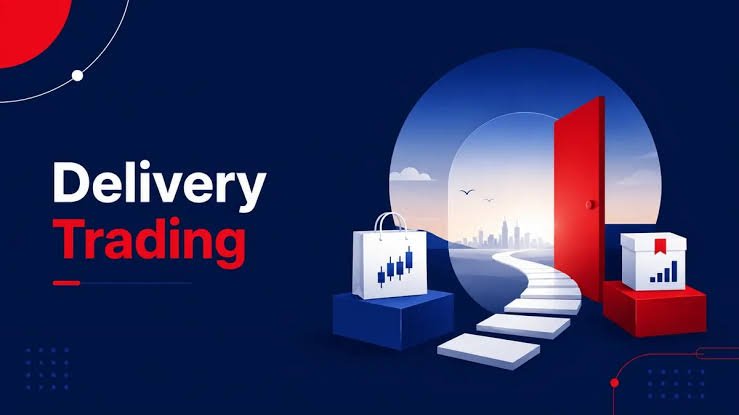
Delivery trading is associated with ownership and a longer view of the stock market. Instead of closing a position on the same day, an investor buys shares and allows them to move into the demat account after settlement. The shares can then be held for days, months or years.
This approach removes minute-by-minute pressure, but not market risk. A delivery investor can lose money if the company performs poorly, the industry weakens or the broader market declines. The main advantage is time; the main challenge is choosing sound investments and holding them through normal price fluctuations.
What Is Delivery Trading?
Delivery trading means buying shares with the intention of taking ownership rather than closing the trade on the same day. Once the transaction is settled, the securities are credited to the investor’s demat account and may be held according to the investor’s strategy.
For example, buying 50 shares at ₹400 and holding them after the session ends creates a ₹3,000 unrealised gain if the price later reaches ₹460, before charges and taxes. If it falls to ₹350, the unrealised loss is ₹2,500. The investor is not forced to exit at the end of the day.
Advantages of Delivery Trading
1. Encourages Long-Term Thinking
Delivery trading allows investors to focus on a company’s business, earnings, management and future prospects instead of reacting to every intraday price movement. This makes it easier to build an investment thesis and give the company time to grow.
2. No Daily Square-Off Pressure
A delivery position does not normally have to be closed before the market shuts. Investors can avoid the daily pressure of selecting an exit within a few hours and may continue holding the shares while reassessing the business and market conditions.
3. Potential for Wealth Creation
Strong companies can grow revenues, profits and market value over time. Investors who identify such businesses may benefit from price appreciation. Delivery holdings may also provide exposure to dividends, bonus issues or other corporate actions when applicable conditions are met.
4. Lower Emotional Pressure Than Intraday Trading
Delivery trading is generally less dependent on second-by-second decisions. Investors have more time to review financial statements, compare valuations and consider whether a fall is temporary or connected to a deeper business problem. This slower pace can reduce impulsive buying and selling.
5. Greater Control Over the Holding Period
The investor can decide whether to hold for a short period, a full business cycle or several years. There is no fixed requirement to exit simply because the session has ended. This flexibility can be useful when the original investment thesis remains valid.
Disadvantages of Delivery Trading
1. Capital Remains Invested
Money used to buy delivery shares remains exposed to the investment until the shares are sold. If the price stays weak for a long period, the capital may not be available for other opportunities. Investors should therefore maintain an emergency fund separately and avoid using money needed for near-term expenses.
2. Overnight and Market-Wide Risk
Because delivery positions remain open after the trading session, they are exposed to overnight news, global market movements, company announcements, interest-rate changes and political events. A stock can open sharply higher or lower than its previous closing price.
3. Losses Can Become Larger Over Time
Holding a share for a long time does not guarantee recovery. A weak company may continue losing market value, reduce dividends or face financial difficulty. Investors should not hold a declining stock blindly merely because they want to avoid booking a loss.
4. Requires Fundamental Research
Delivery trading is not simply a slower version of intraday trading. Investors should study revenue, profitability, debt, cash flow, competition, management quality, valuation and sector conditions. Buying only because a share price has fallen can be dangerous if the business is deteriorating.
5. Opportunity Cost
A stock that moves sideways can prevent capital from being used in stronger investments. This is the opportunity cost of holding. Investors should review whether the original reason for buying still exists and whether the position remains suitable.
6. Concentration Can Increase Risk
Putting too much money into one company or sector can make a portfolio vulnerable to a single setback. Diversification does not eliminate losses, but can reduce the damage caused by one weak investment. Position size should be based on risk, not excitement or a tip.
Who Should Consider Delivery Trading?
Delivery trading may suit investors who have a longer time horizon, can tolerate price fluctuations and are willing to research companies. It may also suit people who cannot monitor the market throughout the day. Beginners should avoid putting all their savings into one share and should learn basic financial analysis.
It may not suit someone who needs quick profits, requires the money soon or becomes anxious whenever prices fall. Investors with short-term goals should avoid exposing essential funds to shares because prices can remain unpredictable.
Final Thoughts
Delivery trading offers ownership, flexibility and possible long-term wealth creation, but it is not risk-free. Investors must choose carefully, diversify sensibly and review the original investment reason. A falling share is not automatically a bargain, and time cannot repair a weak business.
The strongest approach is to invest with a clear time horizon, suitable position size and realistic expectations. Delivery trading works best when patience is combined with research—not when patience becomes an excuse to ignore warning signs.
Frequently Asked Questions
Q1. Is delivery trading the same as long-term investing?
Not exactly. Delivery describes how the shares are held after purchase, while long-term investing describes the investor’s time horizon and strategy. A person can hold delivery shares for a few days, several months or many years. Long-term investing usually involves a longer holding period and a focus on business fundamentals.
Q2 Can delivery shares be sold on the same day?
The answer depends on the order type, broker process and settlement rules. If an investor wants to buy and sell within the same session, the transaction may be treated as intraday rather than delivery. Investors should check the product type selected on the trading platform because charges and risk treatment may differ.
Q3. What happens to dividends and bonus shares in delivery trading?
Eligible shareholders may receive dividends or benefits from corporate actions such as bonus issues, subject to the company’s announcement, record date and applicable settlement conditions. These benefits are not guaranteed and should not be the only reason for buying a share. Investors should read the official corporate-action information carefully.
Q4. How are profits from delivery trading taxed in India?
Tax treatment generally depends on factors such as the holding period, the type of security, the nature of the transaction and the investor’s circumstances. Profits may fall under applicable capital-gains rules, while losses can have separate adjustment and carry-forward provisions. Investors should preserve contract notes and consult a qualified tax professional before filing returns.