Real estate investors often have different approaches to making money from property. Some prefer to buy a property, improve or hold it for a relatively short period and sell it for a potential profit. Others purchase property with the intention of holding it for many years, earning rental income and potentially benefiting from long-term appreciation.
This leads to an important question: Short-Term vs Long-Term Real Estate Investment—which approach is better?
There is no universal answer. The appropriate strategy depends on the investor’s capital, financial objectives, market knowledge, risk tolerance, liquidity needs, taxation, financing costs and investment horizon. Short-term investing may offer the possibility of quicker gains but can involve greater transaction and market-timing risks. Long-term investing can provide more time for rental income and potential appreciation to accumulate, but it also requires patience and the ability to keep capital invested for an extended period.
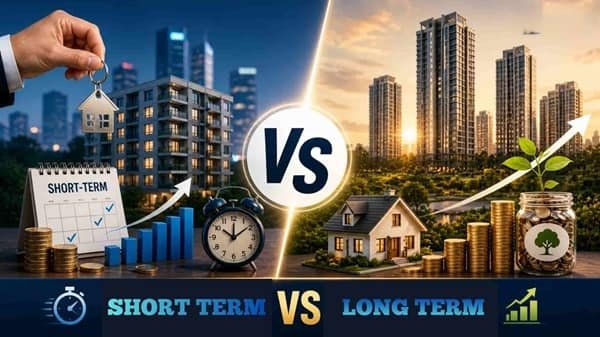
Understanding the differences is essential before choosing a strategy.
What Is Short-Term Real Estate Investment?
Short-term real estate investing generally involves purchasing a property with the intention of selling it within a relatively short period.
The investor may attempt to benefit from:
- A rise in property prices
- Development of infrastructure around the property
- Renovation or improvement
- Buying below perceived market value
- Changes in local demand
- Short-term market opportunities
For example, an investor may purchase an unfinished or undervalued property, make improvements and sell it after a period of time.
However, short-term property investment is not simply a matter of buying low and selling high. The investor must account for acquisition costs, financing costs, renovation expenses, brokerage, taxes and selling expenses.
If property prices do not rise sufficiently to cover these costs, the expected profit may disappear.
What Is Long-Term Real Estate Investment?
Long-term real estate investment involves holding a property for several years or longer.
The investor may generate returns through a combination of rental income and capital appreciation. Instead of attempting to predict short-term price movements, the strategy focuses on the property’s long-term potential.
Residential apartments, commercial properties and other real estate assets can be held for long periods depending on the investor’s objectives.
A long holding period can also give the investor more time to benefit from changes such as population growth, infrastructure development, economic expansion and increasing demand for property.
However, long-term ownership does not guarantee appreciation. A poorly selected property can underperform for years.
Short-Term vs Long-Term Real Estate: Key Differences
| Factor | Short-Term Investment | Long-Term Investment |
| Holding period | Relatively short | Several years or longer |
| Main objective | Potential capital gain | Appreciation and/or rental income |
| Market timing | More important | Generally less important |
| Transaction costs | Can have greater impact | Spread over longer holding period |
| Rental income | May be limited | Can accumulate over time |
| Management | May involve frequent transactions | More stable ongoing management |
| Risk | Greater exposure to short-term price movements | Greater exposure to long-term market and property risks |
| Liquidity need | Higher | Usually lower |
| Financing pressure | Can be significant | May be easier to manage over time |
| Patience required | Moderate | High |
The Importance of Transaction Costs
One of the biggest challenges of short-term property investing is the cost of buying and selling.
Property transactions can involve stamp duty, registration charges, brokerage, legal expenses and other costs. Renovation or improvement can add further expenditure.
When the property is sold, brokerage and other selling-related expenses may again reduce the investor’s net gain.
This means a property may increase in market value but still produce a modest or negative net return after all costs.
Long-term investors generally have more time for appreciation and rental income to offset these expenses.
Therefore, investors should calculate the net return, rather than simply comparing the purchase price with the selling price.
Rental Income and Cash Flow
Long-term property ownership can provide an important advantage: the possibility of regular rental income.
A residential property can be rented to individuals or families, while commercial property can be leased to businesses. Rental income can help offset maintenance costs, property taxes and financing expenses.
Short-term investors who plan to sell quickly may not benefit from rental income for a significant period.
Market Timing and Price Risk
Short-term investing generally requires greater attention to market conditions.
If an investor buys shortly before a decline in local property prices, selling quickly may result in a loss. Even if prices eventually recover, the investor may not have enough time to wait.
Long-term investors can potentially withstand shorter periods of weak prices because they have a longer investment horizon. However, a long holding period does not eliminate risk. Property prices can remain stagnant for extended periods, and some locations may experience structural declines in demand.
Financing Can Change the Outcome
Many investors use loans to purchase property. Financing can influence both short-term and long-term strategies.
For a short-term investor, loan interest can accumulate quickly and reduce the expected profit if the property takes longer than expected to sell.
Long-term investors may have more time to spread financing costs across a longer holding period, but they still need to manage monthly repayments.
Before borrowing, investors should assess their income stability, existing liabilities, interest rate, repayment schedule and ability to manage the loan if rental income stops temporarily.
Using excessive leverage can turn a property investment into a significant financial burden.
Risk of Holding Period
Short-term investing can expose investors to:
- Market-timing risk
- Higher transaction costs
- Renovation expenses
- Financing costs
- Difficulty finding a buyer quickly
- Unexpected price declines
Long-term investing can involve:
- Long periods of low price growth
- Maintenance expenses
- Vacancy risk
- Changing neighbourhood conditions
- Property obsolescence
- Capital being locked into an illiquid asset
The risks are different rather than one strategy being automatically risk-free.
Who May Consider a Short-Term Strategy?
Short-term real estate investment may be considered by investors who:
- Have strong knowledge of the local property market
- Can identify potential value opportunities
- Have sufficient capital to absorb unexpected costs
- Understand renovation and transaction expenses
- Can tolerate price fluctuations
- Do not depend on immediate returns
- Have carefully evaluated the exit strategy
It is important to have a realistic selling plan before purchasing the property.
Who May Consider a Long-Term Strategy?
Long-term real estate investment may be considered by investors who:
- Have a long investment horizon
- Prefer potential rental income
- Can tolerate lower liquidity
- Want to hold a tangible asset
- Can manage maintenance and ownership costs
- Have sufficient financial reserves
- Do not need the invested capital immediately
Long-term investing requires patience because property appreciation may not occur consistently every year.
How to Evaluate a Property Before Investing
Regardless of the strategy, investors should conduct thorough due diligence.
Check:
- Property title and ownership
- Encumbrances and legal disputes
- Approvals and required permissions
- Location and connectivity
- Current rental demand
- Comparable property prices
- Expected maintenance expenses
- Financing costs
- Potential resale demand
- Applicable taxes and transaction costs
Investors should also calculate the expected return under different scenarios.
For example, ask what happens if the property takes six months longer to sell, prices remain flat, renovation costs increase or rental income is lower than expected.
Can Investors Combine Both Strategies?
An investor does not necessarily have to follow only one approach.
Some investors may hold a long-term rental property while occasionally identifying shorter-term opportunities. However, combining strategies requires careful capital allocation and separate risk management.
The investor should ensure that short-term investments do not jeopardise the ability to maintain long-term holdings or meet loan obligations.
Conclusion
The comparison between Short-Term vs Long-Term Real Estate Investment depends on the investor’s financial goals, knowledge, risk tolerance and ability to hold property.
Short-term investing can potentially generate quicker capital gains, but it requires careful market analysis and exposes the investor to transaction costs, financing expenses and market-timing risk. A price increase alone does not guarantee a profitable investment after all costs.
Long-term investing can provide more time for rental income and potential appreciation to accumulate. It can also reduce the importance of short-term price movements, but it requires patience and the ability to manage maintenance, vacancies and an illiquid asset over many years.
Neither strategy guarantees a profit.
Before investing, investors should evaluate purchase price, expected rental income, transaction costs, financing, taxes, market conditions, liquidity and exit strategy. The better approach is the one that fits the investor’s financial capacity and objectives rather than the one that promises the fastest possible return.