Commercial property is often considered an attractive real estate investment because it can generate rental income while potentially appreciating in value over time. Office spaces, retail shops, warehouses, showrooms and other commercial units can provide income opportunities that differ from residential property.
But is commercial property a good investment for beginners? It can be, but it is not automatically suitable for every first-time investor. Commercial real estate usually involves higher capital requirements, greater dependence on tenants and location, more complex agreements, and lower liquidity than many financial investments. A beginner should therefore understand the property, rental economics, legal documents and risks before committing significant capital.

What Is Commercial Property Investment?
Commercial property refers to real estate primarily used for business or income-generating activities. Common examples include:
- Office spaces
- Retail shops and high-street stores
- Showrooms
- Warehouses and logistics properties
- Industrial units
- Commercial buildings
- Certain hospitality and mixed-use properties
An investor may purchase a commercial property and lease it to a business. The investment can potentially generate two forms of return: rental income during ownership and capital appreciation if the property is later sold at a higher price.
However, neither rental income nor appreciation is guaranteed. Real estate markets can differ significantly between cities, neighbourhoods and individual properties.
Why Do Beginners Consider Commercial Property?
One major attraction is the possibility of rental income. A well-located commercial property with a suitable tenant may generate regular rent for the owner.
Commercial leases can also have longer contractual terms than many residential arrangements. Depending on the property and agreement, tenants may occupy premises for several years, creating greater visibility of contractual rental cash flows.
Another potential benefit is capital appreciation. If an area develops because of improved infrastructure, employment growth, population expansion or increasing business activity, demand for commercial space may increase.
However, investors should evaluate these possibilities rather than assuming that every commercial property will appreciate or remain occupied.
Potential Benefits of Commercial Property
1. Rental Income
Rental income is one of the main reasons investors consider commercial real estate. A property leased to a business can provide periodic cash flow.
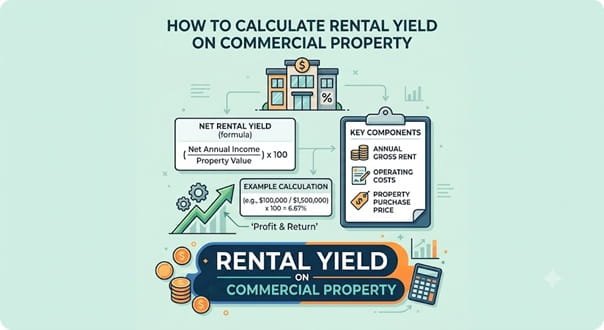
The important figure is not simply the advertised rent. Investors should calculate the net rental yield after considering vacancy, maintenance, property tax, insurance, brokerage, repairs, financing costs and other applicable expenses.
2. Potential Capital Appreciation
Commercial property can appreciate when demand for business space increases. Location is particularly important.
Properties near established business districts, transport infrastructure, major roads, commercial clusters and growing employment centres may experience different demand conditions from properties in less-developed areas.
Past price growth, however, does not guarantee future appreciation.
3. Longer Tenant Relationships
Some commercial tenants may sign longer leases because moving a business can involve relocation costs, fit-outs and operational disruption.
A longer lease can provide greater contractual visibility, although investors should examine the actual lease terms, lock-in provisions, escalation clauses, renewal conditions and termination rights.
4. Portfolio Diversification
Real estate can form one part of a broader investment portfolio. Direct commercial property may behave differently from financial assets such as equities or bonds.
At the same time, putting most of one’s wealth into a single property creates concentration risk. SEBI material has highlighted that real estate investments can be relatively illiquid and “lumpy,” making diversification difficult for individual investors.
Why Commercial Property Can Be Difficult for Beginners
Commercial property has several characteristics that first-time investors should understand before purchasing.
High Initial Capital
Commercial properties can require substantial upfront capital. Besides the purchase price, buyers may have to account for stamp duty, registration charges, brokerage, legal expenses, fit-out costs and financing-related expenses.
Using a large loan can increase the potential return on the investor’s own capital, but it also increases financial obligations. If the property remains vacant, loan repayments may continue even when rental income stops.
Vacancy Risk
A commercial property does not automatically generate rent simply because it is purchased.
Tenant demand can change because of economic conditions, business closures, competition, changing consumer behaviour, new construction or changes in the surrounding area.
A property with attractive projected rent but frequent vacancy may produce a very different actual return from the original calculation.
Location Risk
Commercial real estate is highly location-sensitive. Two properties in the same city can have completely different rental demand and resale prospects.
Before buying, investors should examine accessibility, parking, public transport, nearby businesses, customer footfall where relevant, competing properties, future development and the type of businesses likely to need space in that location.
Lower Liquidity
Selling a property can take considerable time. Unlike many exchange-traded financial investments, a direct property cannot normally be converted into cash instantly at a transparent market price.
SEBI-filed real estate disclosures also identify illiquidity as a risk that can limit an owner’s ability to respond quickly to changing market conditions.
What Should Beginners Check Before Buying?
A beginner should avoid making a decision based only on the quoted price or promised rental yield.
1. Calculate the Real Rental Yield
Suppose a commercial unit costs ₹1 crore and generates ₹6 lakh in annual rent. The simple gross rental yield is:
₹6 lakh ÷ ₹1 crore × 100 = 6%
But this is not necessarily the investor’s actual return. Vacancy, maintenance, taxes, brokerage, repairs, financing costs and other expenses can reduce the net cash flow.
Always calculate both gross and estimated net yield.
2. Check the Tenant
The quality of the tenant can matter almost as much as the property.
Review the tenant’s business, lease period, rent payment history, security deposit, lock-in clause, escalation provisions and termination conditions. A high rent from an unreliable tenant may create more risk than a sustainable rent from a stable occupant.
3. Study the Lease Agreement
Read the complete lease carefully. Important provisions include:
- Monthly or annual rent
- Security deposit
- Rent escalation
- Lock-in period
- Notice period
- Renewal rights
- Maintenance responsibilities
- Property taxes and other charges
- Permitted use
- Subleasing provisions
- Early termination
- Restoration and handover conditions
For large transactions, having the agreement reviewed by a property lawyer can help identify issues before signing.
4. Conduct Legal Due Diligence
Before purchasing, verify ownership and title documents and check for encumbrances, pending disputes, approvals and applicable land-use restrictions.
Depending on the property, buyers may also need to examine building approvals, occupancy or completion documentation, local permissions and other regulatory requirements.
Do not rely solely on the seller’s verbal assurances.
5. Understand the Financing
Loan affordability should be tested against realistic rental income rather than optimistic assumptions.
A useful exercise is to calculate whether you could continue paying the loan if the property remained vacant for several months.
Interest rates, financing availability and economic conditions can affect property demand and investment economics. Real estate risk disclosures filed with SEBI also identify financing conditions, interest rates, local demand and regulatory changes among factors that can affect property markets.
What About Taxes?
Tax treatment should be considered before purchasing because rental income and eventual sale of property can have tax implications.
The exact treatment depends on the nature of the property, ownership structure, income, expenses, holding period and applicable provisions of the Income-tax Act and related rules. The Income Tax Department’s current guidance also distinguishes between income from house property, business or profession and capital gains depending on the circumstances.
Because commercial-property taxation can become complicated, investors should calculate the post-tax cash flow rather than relying only on the advertised rental yield. A qualified tax professional can help with transaction-specific calculations.
Conclusion
Commercial property can be an income-generating and potentially appreciating asset, but it requires more than simply purchasing a shop or office and waiting for rent to arrive.
For beginners, the most important considerations are location, tenant quality, rental yield, vacancy risk, legal due diligence, financing, taxes, liquidity and total ownership costs. A property with a high advertised rental yield may not necessarily produce the highest actual return after expenses and vacancies.
Direct commercial property may suit investors who have sufficient capital, a long investment horizon and the ability to manage property-related responsibilities. Beginners with limited capital or a preference for liquidity may want to compare direct property with other real-estate and financial investment options before making a decision.
The key is to evaluate the complete economics of the property—not just its price, expected rent or future appreciation.