Real estate is often considered a long-term investment avenue in India, but investors face an important choice when selecting a property. Both rental and commercial property can generate rental income and potentially appreciate in value, but their investment characteristics are quite different.
Residential property generally includes apartments, houses and other homes rented to individuals or families. Commercial property can include office spaces, retail shops, commercial buildings, warehouses and other properties used for business purposes.

So, there is no universal answer. The appropriate choice depends on the investor’s capital, expected rental income, location, risk tolerance, investment horizon, liquidity requirements and willingness to manage tenants and property-related responsibilities.
What Is Rental Property Investment?
Rental property usually refers to residential property purchased primarily to generate regular rental income. An investor may purchase an apartment, independent house or other residential unit and lease it to tenants.
The investor can potentially benefit from two sources of returns: rental income and capital appreciation. If the property’s market value increases over time, the investor may gain from selling it later at a higher price.
Residential rental property can also provide relatively broad tenant demand because people require housing regardless of their employment sector or business activity. However, demand varies considerably between cities and neighbourhoods.
What Is Commercial Property Investment?
Commercial property is purchased or leased for business-related activities. Examples include office spaces, retail shops, warehouses, industrial properties and other commercial units.
Commercial property can potentially generate higher rental income relative to the purchase price. Tenants may also sign longer leases, depending on the property and agreement.
However, commercial properties can require a larger initial investment and more specialised due diligence. The property’s location, footfall, accessibility, surrounding businesses, tenant profile and local economic activity can have a significant impact on demand.
A commercial property in an unsuitable location may remain vacant for a long period, creating a substantial cash-flow problem for the owner.
Rental Property vs Commercial Property: Key Differences
| Factor | Residential Rental Property | Commercial Property |
| Main tenants | Individuals/families | Businesses |
| Initial investment | Usually lower than comparable commercial assets | Often higher |
| Rental yield | Generally lower | Potentially higher |
| Lease period | Often shorter | Can be longer |
| Vacancy risk | Depends on location and demand | Can be significant during tenant turnover |
| Tenant management | Usually relatively straightforward | Can involve more complex requirements |
| Maintenance | Regular maintenance required | May involve specialised maintenance |
| Location factors | Housing demand, schools, transport, employment | Business activity, footfall, connectivity, infrastructure |
| Liquidity | Relatively low | Relatively low |
| Due diligence | Title, approvals, building condition | Title, zoning, approvals, leases, tenant and commercial viability |
Rental Income: Commercial Property May Offer Higher Potential
One of the main reasons investors consider commercial property is its potential rental yield.
Businesses may be willing to pay higher rent for locations that provide visibility, accessibility, customer footfall or proximity to business hubs. Commercial leases may also contain provisions relating to rent increases, maintenance responsibilities and security deposits.
However, a higher potential yield does not automatically mean a higher overall return.
A commercial property can remain vacant for an extended period if a suitable tenant cannot be found. During vacancy, the owner may still have to pay maintenance charges, property taxes, loan instalments and other expenses.
Residential property can also experience vacancies, but the tenant pool may be broader in areas with strong housing demand.
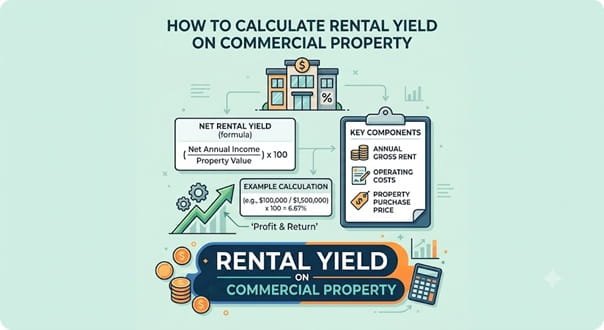
Therefore, investors should compare net rental yield, not simply the advertised monthly rent.
Initial Investment and Financing
Residential properties are often more accessible to individual investors because apartments and houses are available across a wide range of prices.
Commercial properties can require substantially more capital, particularly in established business districts or high-demand retail locations.
Financing also needs careful consideration. Investors using loans should calculate the total interest cost and compare it with expected rental income. A property producing attractive rent on paper may still generate negative cash flow after loan interest, maintenance, taxes and vacancy periods.
A sensible evaluation should therefore consider the investor’s own capital contribution, borrowing cost and expected net income.
Tenant and Vacancy Risk
Tenant risk exists in both categories, but the nature of the risk can differ.
For residential property, tenants may move because of job transfers, family changes, affordability or personal circumstances. A landlord may therefore experience periodic vacancies.
Commercial tenants may occupy a property for longer periods, but losing one major tenant can have a significant financial impact, particularly when the property is designed for a specific business.
For example, a specialised commercial unit may be difficult to lease to another tenant without modification.
Before investing, investors should consider not only how much rent a property can generate, but also how easily another tenant could replace the existing one.
Maintenance and Operating Costs
Property ownership involves ongoing expenses.
Residential landlords may have to pay for repairs, painting, appliances, plumbing, electrical work, society charges and other maintenance expenses depending on the property and rental agreement.
Commercial properties can have additional costs because business tenants may require specific infrastructure, interiors, air-conditioning, security systems, elevators or other facilities.
The lease agreement should clearly define which expenses are paid by the landlord and which are the tenant’s responsibility.
When calculating returns, investors should deduct these costs from rental income to determine the property’s actual cash flow.
Capital Appreciation
Rental income is only one part of a property investment.
Both residential and commercial properties can potentially appreciate in value over time. However, appreciation depends on location, supply and demand, infrastructure development, economic conditions and the property’s characteristics.
Commercial property may benefit from the expansion of business districts, infrastructure and commercial activity. Residential property may benefit from population growth, employment opportunities and housing demand.
Past appreciation does not guarantee future price increases. Investors should avoid purchasing property solely because prices in the area have risen recently.
Risk and Liquidity
Direct property investment is relatively illiquid. Selling can take time because the owner must identify a buyer, negotiate a price and complete documentation and registration procedures.
SEBI investor education material highlights the illiquid and “lumpy” nature of direct real estate investment, as well as property-specific risks and the difficulty of diversifying when a large amount of wealth is concentrated in one property.
Commercial property can sometimes have an even narrower buyer and tenant base because of its specialised nature.
Investors should therefore avoid committing money that they may need to access quickly.
Which May Suit Different Investors?
Residential rental property may be considered by investors who:
- Want exposure to housing demand
- Have moderate-to-high capital available
- Prefer a wider potential tenant base
- Want rental income
- Are comfortable managing tenants
- Prefer a tangible, directly owned asset
Commercial property may be considered by investors who:
- Can commit larger amounts of capital
- Are seeking potentially higher rental yields
- Understand commercial leasing
- Can tolerate vacancy and tenant-concentration risks
- Have researched the local business environment
- Can manage longer investment horizons
These characteristics do not guarantee returns or make either category suitable for every investor.
Can Investors Consider Both?
Investors do not necessarily have to choose only residential or commercial property.
A diversified real estate strategy may include different property types if the investor has sufficient capital and understands the associated risks. However, owning several properties does not automatically create adequate diversification if all of them are concentrated in the same city, locality or economic segment.
Investors can also consider regulated market-based real estate instruments such as REITs if they want exposure to real estate without directly purchasing and managing physical property. SEBI maintains a current register of recognised REITs in India.
Conclusion
The comparison between Rental Property vs Commercial Property ultimately depends on the investor’s objectives rather than a simple answer about which is “better.”
Residential rental property may offer broader housing demand, comparatively accessible entry points and potential rental income, but rental yields can be relatively modest and vacancies and maintenance can affect cash flow.
Commercial property can potentially offer higher rental yields and longer leases, but it may require greater capital and involve higher tenant concentration, specialised property requirements and potentially longer vacancy periods.
The right choice requires investors to examine net rental yield, purchase price, vacancy risk, maintenance costs, financing, location, tenant demand, liquidity and potential appreciation.