Rental yield is one of the most useful metrics for evaluating an income-generating commercial property. It helps an investor compare the rent earned from a property with the amount invested in acquiring it. However, simply dividing annual rent by the purchase price can give an incomplete picture.
For a commercial property in India, investors should distinguish between gross rental yield and net rental yield. They should also account for vacancy, maintenance, taxes, brokerage, transaction costs, financing and other property-related expenses. A property with a high advertised rent is not necessarily a better investment if a large portion of that income is consumed by expenses or periods of vacancy.
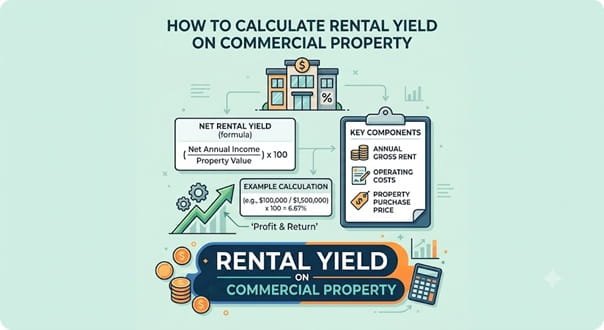
What Is Rental Yield?
Rental yield is the annual rental income generated by a property expressed as a percentage of the property’s investment cost or value.
The basic formula is:
Gross Rental Yield = (Annual Rental Income ÷ Property Cost) × 100
For example, suppose a commercial shop costs ₹1 crore and earns ₹6 lakh in annual rent.
Gross Rental Yield = (₹6 lakh ÷ ₹1 crore) × 100 = 6%
This 6% is the gross rental yield. It does not account for expenses, vacancy or taxes.
What Is Included in Property Cost?
Do not use only the seller’s quoted price. A more useful calculation includes purchase price plus applicable stamp duty, registration, brokerage, legal expenses, initial renovation or fit-out and other acquisition costs.
For example, if a property costs ₹1 crore and acquisition expenses add ₹8 lakh, the investment cost is ₹1.08 crore. With ₹6 lakh annual rent, the yield on total cost is approximately 5.56%, rather than 6% when only the purchase price is used.
How to Calculate Gross Rental Yield
Suppose a commercial office earns ₹75,000 per month and the total acquisition cost is ₹1.5 crore.
Annual rent = ₹75,000 × 12 = ₹9 lakh
Gross yield = ₹9 lakh ÷ ₹1.5 crore × 100 = 6%
Gross yield is useful for quickly screening properties, but it does not show the owner’s actual cash flow.
How to Calculate Net Rental Yield
Net rental yield gives a better picture because it considers operating expenses and income that may not actually reach the owner.
The simplified formula is:
Net Rental Yield = (Net Annual Rental Income ÷ Total Investment Cost) × 100
Net annual rental income can be estimated by subtracting relevant annual expenses from rental income.
Potential expenses include:
- Property maintenance
- Repairs
- Property management fees
- Property tax paid by the owner
- Insurance
- Common-area charges borne by the owner
- Brokerage or leasing costs
- Vacancy-related income loss
- Other recurring property expenses
Consider a property costing ₹1.5 crore that generates ₹9 lakh in annual rent. Assume annual owner-paid expenses total ₹1.2 lakh.
Net rental income = ₹9 lakh − ₹1.2 lakh = ₹7.8 lakh
Net rental yield = ₹7.8 lakh ÷ ₹1.5 crore × 100 = 5.2%
The net yield of 5.2% is more informative for assessing the property’s ongoing cash generation than the 6% gross figure.
How Vacancy Affects Rental Yield
Commercial property can remain vacant between tenants. This is particularly important when the property is located in a market with high competition or when the premises is highly specialised.
Suppose annual contractual rent is ₹9 lakh, but the property is expected to remain vacant for two months during a tenant change.
Estimated rent actually received:
₹75,000 × 10 = ₹7.5 lakh
If annual operating expenses are ₹1.2 lakh:
Net rental income = ₹7.5 lakh − ₹1.2 lakh = ₹6.3 lakh
On a ₹1.5 crore investment, the effective net rental yield becomes 4.2%.
This example shows why investors should calculate yield using realistic occupancy assumptions instead of assuming 12 months of rent every year.
Rent Escalation and Rental Yield
Commercial leases may include rent escalation clauses, but future increases should not automatically be treated as guaranteed investment returns.
Suppose a tenant currently pays ₹75,000 per month and the lease provides for periodic increases. The investor can model future rental income under the contract, but should also consider the possibility of vacancy, renegotiation, tenant default or changes in market rent.
It is useful to calculate both:
- Current rental yield
- Projected rental yield under the existing lease
This separates today’s income from assumptions about future income.
Market Rent vs Contract Rent
Another important distinction is between the rent actually specified in the lease and the rent the property might command in the current market.
A property may have an existing tenant paying below-market rent. In that case, the current rental yield could look low even though there may be an opportunity to increase rent at renewal.
The opposite can also happen. A tenant may be paying an unusually high rent compared with nearby properties, creating a risk that future renewal occurs at a lower rate.
For this reason, investors should compare the property’s rent with similar commercial properties in the same location.
Should Loan Interest Be Included?
Rental yield is generally used to assess the property’s income relative to its cost, while loan-related metrics measure the return and cash flow on the investor’s own capital.
Therefore, it is useful to calculate property yield separately from financing costs.
For example, if an investor buys a ₹1.5 crore property using a combination of personal funds and a loan, interest payments can significantly reduce monthly cash flow. But including the loan interest directly in the basic rental-yield formula can make comparisons with unleveraged properties less consistent.
Instead, investors can calculate additional measures such as annual cash flow after interest and cash-on-cash return.
Rental Yield vs Capital Appreciation
Rental yield is only one part of a commercial property’s potential return.
An investor may earn rental income while the property’s market value changes over time. The overall investment outcome can therefore involve:
- Rental income
- Capital appreciation or depreciation
- Transaction costs
- Taxes
- Financing costs
- Holding and maintenance expenses
A lower-yield property could have a different overall return profile if its location, tenant quality and demand are stronger. Conversely, a high-yield property may carry greater vacancy, tenant, legal or location risks. Avoid choosing a property solely because it advertises a high yield.
Tax Considerations
Rental income can have tax implications, and the applicable treatment depends on the owner’s circumstances and how the property and income are classified.
The Income Tax Department’s current return guidance provides for reporting rental-related income and distinguishes between income from house property, business or profession and capital gains depending on the circumstances. The department’s notified forms also include fields for gross rent, unrealised rent and local-authority taxes in relevant house-property calculations. These tax calculations are separate from the investment metric of rental yield.
Investors should calculate post-tax cash flow where relevant and obtain professional tax advice for transaction-specific situations.
A Practical Commercial Property Rental Yield Example
Consider a shop with the following figures:
- Purchase price: ₹1.20 crore
- Acquisition costs: ₹10 lakh
- Total investment: ₹1.30 crore
- Monthly rent: ₹80,000
- Annual contractual rent: ₹9.60 lakh
- Expected vacancy: 1 month
- Owner-paid annual expenses: ₹1 lakh
Rent after one month of vacancy:
₹80,000 × 11 = ₹8.80 lakh
Net annual rental income:
₹8.80 lakh − ₹1 lakh = ₹7.80 lakh
Net rental yield:
₹7.80 lakh ÷ ₹1.30 crore × 100 = 6%
The gross yield based on full contractual rent would be approximately 7.38%, but the estimated net yield after vacancy and operating expenses is 6%.
Conclusion
Calculating rental yield on commercial property is straightforward, but calculating a useful rental yield requires more than dividing annual rent by the purchase price.
Start with gross rental yield to compare properties quickly. Then calculate net rental yield by including realistic acquisition costs, vacancy and recurring expenses. Finally, consider financing, taxes, lease terms, tenant quality and potential capital appreciation.
The most useful number is not necessarily the highest advertised yield. It is the yield supported by realistic rent, sustainable occupancy, verified expenses and a property whose legal and financial fundamentals have been properly checked.