Renting a home, office, shop, or other property usually involves a written agreement between the owner and occupant. In everyday conversation, the terms are often used interchangeably. Legally, however, they can describe arrangements with different structures, durations, and rights.
In India, a lease has a specific meaning under the Transfer of Property Act, 1882. Section 105 describes it as a transfer of the right to enjoy immovable property for a certain time in return for a price, rent, or other consideration. Therefore, the title of a document is less important than the rights and obligations it actually creates.
What Is a Rent Agreement?
A rent agreement is a contract that sets out the terms under which a tenant occupies a property and pays rent to the owner. It is commonly used for residential arrangements.
A typical agreement covers the parties, property, rent, deposit, duration, notice period, maintenance, utilities, restrictions, termination and handover conditions.
In common Indian usage, “rent agreement” often refers to a shorter residential arrangement, sometimes for 11 months. However, an 11-month label does not by itself determine the legal status or registration requirements. The actual terms, applicable law and location of the property matter.
What Is a Lease Agreement?
A lease agreement grants the lessee a right to enjoy an immovable property for an agreed period on specified terms. Section 105 of the Transfer of Property Act provides the statutory definition of a lease.
Leases can cover residential, commercial, industrial and other properties. They are often used when the parties want a clearly defined tenure and detailed conditions governing possession.
A lease may cover the fixed period, rent, deposit, permitted use, maintenance, rent escalation, renewal, termination, subletting, alterations and handover obligations.
Rent Agreement vs Lease Agreement: Key Differences
The most important distinction is not simply the name of the document. Its legal effect depends on the rights and obligations created by the contract.
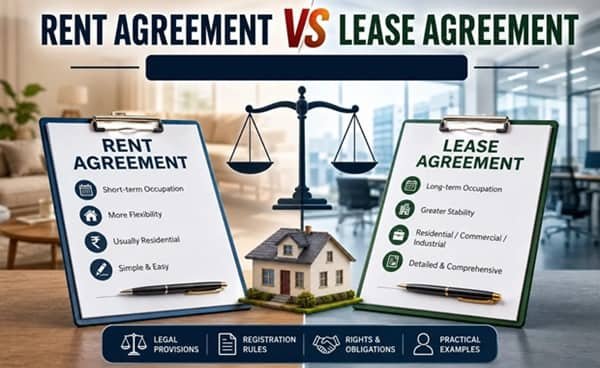
| Aspect | Rent Agreement | Lease Agreement |
| Common usage | Often used for ordinary residential renting | Often used for fixed-term or more formal arrangements |
| Duration | Frequently short-term, depending on the contract | Commonly a defined tenure and can be long-term |
| Legal nature | Contract setting out occupation and rent terms | Transfer of a right to enjoy immovable property for a specified period |
| Flexibility | May provide periodic renewal or termination | Often more structured for the agreed tenure |
| Registration | Depends on duration, terms and applicable state law | Certain longer leases require registration |
| Typical use | Homes and short residential arrangements | Commercial, industrial and longer residential arrangements |
These are general distinctions. A document called a “rent agreement” can create lease rights, while a document called a “lease agreement” can contain many of the same practical clauses found in a rental contract.
Does an 11-Month Rent Agreement Need Registration?
This is one of the most common questions in India. The answer depends on the document and the applicable law.
Section 17 of the Registration Act, 1908 requires registration of leases of immovable property from year to year, for a term exceeding one year, or reserving a yearly rent. Section 18 separately lists leases for terms not exceeding one year among documents that may be registered.
Section 107 of the Transfer of Property Act states that a lease from year to year, for a term exceeding one year, or reserving a yearly rent can be made only by a registered instrument.
Consequently, it is not accurate to assume that every document described as an “11-month rent agreement” automatically has no registration or stamping requirements. State-specific rules can also affect stamp duty, registration procedure and costs.
For example, the Delhi Department of Revenue publishes registration information and identifies lease deeds among documents requiring registration. It also provides details about registration fees and the applicable property-registration process. The rules should be checked for the state where the property is located.
Stamp Duty and Registration: What Is the Difference?
Stamp duty and registration are related but different.
Stamp duty is a statutory charge imposed on certain instruments under applicable stamp laws. Registration is the formal recording of a document with the registering authority.
The amount and procedure can depend on the state, property and nature of the instrument. In Delhi, for example, the Department of Revenue publishes separate information on stamp duty and registration fees for property documents.
The consequences of non-registration or insufficient stamping can depend on the document, applicable law and purpose for which it is being relied upon. For significant transactions, professional legal advice can be useful.
Which Agreement Is Suitable for Tenants?
There is no universal choice. The appropriate structure depends on the tenant’s needs and the negotiated terms.
A short-term residential tenant may value flexibility around renewal and notice. A business investing in interiors or equipment may need a longer-term arrangement covering renewal, permitted use, maintenance, rent escalation and early termination.
Before signing, tenants should check rent and escalation, deposit and refund conditions, notice or lock-in period, maintenance, utilities, permitted use, subletting, renewal, termination and handover.
What Should Property Owners Check?
Owners should also focus on the substance of the agreement rather than its title.
A residential arrangement may need clear provisions for rent, deposit, maintenance, notice and possession. A commercial arrangement may require additional clauses covering business use, alterations, insurance, compliance responsibilities, rent escalation and default.
Owners should verify the occupant’s identity and authority, describe the premises clearly, document its condition at handover, and keep payment records.
Important Clauses in Both Agreements
Regardless of whether the document is called a rent or lease agreement, it should clearly answer practical questions before occupation begins.
- Parties and property: Identify the landlord, tenant and complete property details.
- Term: State start date, end date and renewal process.
- Rent and deposit: Specify rent, due date, escalation, deposit, deductions and refund process.
- Maintenance and utilities: Clarify responsibility for repairs, electricity, water and other recurring charges.
- Termination: Explain notice requirements and early termination.
- Use and alterations: State permitted use and whether alterations or subletting require consent.
- Handover: Specify the condition in which the property must be returned.
What Should You Check Before Signing?
Do not select a document simply because it is called a “rent agreement” or “lease agreement.” First understand the actual arrangement.
Verify the ownership or authority of the person granting possession. Check the property description, rent, deposit, notice period, lock-in clause, escalation and renewal provisions. Confirm who pays maintenance and utilities. Also check restrictions on guests, pets, commercial use, alterations or subletting where relevant.
Most importantly, confirm whether stamping and registration are required under the law applicable to the property. Long-term arrangements, commercial premises, large deposits and agreements involving major fit-outs deserve particular attention.
Conclusion
A rent agreement and a lease agreement may look similar because both regulate the use of property in exchange for rent or other consideration. The key distinction is the legal structure and rights created by the document, not merely the heading printed on it.
In India, leases are specifically recognised under the Transfer of Property Act, while registration requirements are governed in part by the Registration Act and applicable state rules. Short residential arrangements are commonly called rent agreements, while longer or more formal arrangements are often documented as leases.