Access to business finance remains one of the biggest challenges for women who want to start their first enterprise. A promising business idea may require machinery, premises, inventory and working capital, but a first-time entrepreneur often lacks the business history or assets normally expected for a large commercial loan. The Stand-Up India Scheme was introduced specifically to improve access to institutional finance for women and Scheduled Caste and Scheduled Tribe entrepreneurs.
Under the Stand-Up India framework, eligible women entrepreneurs can obtain a composite bank loan of more than ₹10 lakh and up to ₹1 crore for establishing a new business in manufacturing, services, trading or activities allied to agriculture. The loan can include both term finance for fixed assets and working capital for running the enterprise.
However, applicants in 2026 should note an important development. The Department of Financial Services states that the original Stand-Up India Scheme was formally extended only up to March 31, 2025. The Union Budget 2025-26 announced a successor scheme offering term loans up to ₹2 crore for five lakh women and SC/ST first-time entrepreneurs, but official information in early 2026 indicated that this new programme was still under development. At the same time, the National Portal of India continued to list Stand-Up India in July 2026. Women seeking a fresh loan should therefore confirm current acceptance with the participating bank or official portal before proceeding.
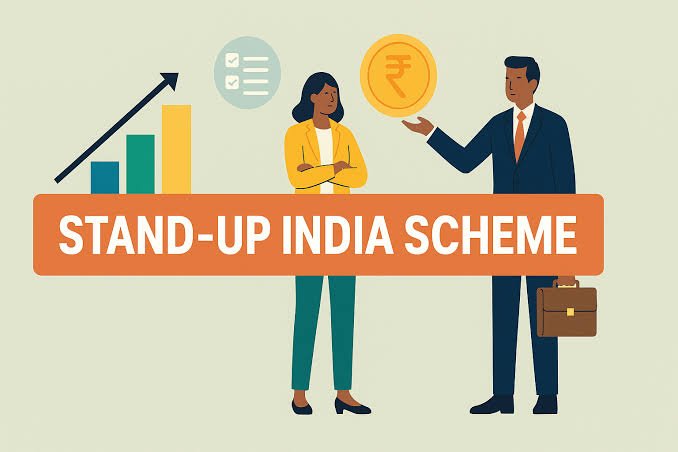
What Is the Stand-Up India Scheme?
Stand-Up India was launched on April 5, 2016 to encourage entrepreneurship among women and SC/ST communities.
Its central objective was to facilitate bank finance to:
- At least one woman entrepreneur per Scheduled Commercial Bank branch
- At least one SC or ST entrepreneur per bank branch
The business must generally be a greenfield enterprise, meaning a first-time venture by the beneficiary in the relevant business activity.
Eligible sectors include:
- Manufacturing
- Services
- Trading
- Activities allied to agriculture
The scheme is intended for genuine business creation rather than personal expenses or ordinary consumption loans.
Can Any Woman Apply for Stand-Up India?
A woman does not need to belong to the SC or ST category to qualify under the women-entrepreneur component.
A general-category woman can qualify if she meets the other conditions.
The principal eligibility requirements are:
- Applicant should be at least 18 years old.
- She should be establishing a greenfield enterprise.
- The proposed activity should fall within an eligible sector.
- She should not be in default to any bank or financial institution.
- The proposed business should be commercially viable.
- Required promoter contribution should be available.
These conditions distinguish Stand-Up India from programmes limited exclusively to economically weaker or reserved-category applicants.
What Does Greenfield Enterprise Mean?
The greenfield condition is one of the most important Stand-Up India eligibility rules.
In this scheme, greenfield broadly means the first-time venture of the beneficiary in the proposed manufacturing, service, trading or eligible agri-allied activity.
The scheme was therefore designed primarily to help women become entrepreneurs rather than simply provide additional finance for routine expansion of an established enterprise.
For example, a woman establishing her first food-processing unit could potentially fit the greenfield requirement. A business that has already been operating for several years and merely wants to purchase additional machinery would normally need to examine another MSME loan product.
Eligibility for Partnership Firms and Companies
A Stand-Up India business does not necessarily have to be a sole proprietorship.
An eligible enterprise can operate through a company, partnership or another permitted organisational structure.
However, where the enterprise is not individually owned, at least 51% of its shareholding and controlling stake must be held by a woman entrepreneur or eligible SC/ST entrepreneur.
This means merely appointing a woman as a nominal director while other persons effectively own and control the business would not satisfy the basic intent of the scheme.
Stand-Up India Loan Amount
The original Stand-Up India framework provides a composite loan above ₹10 lakh and up to ₹1 crore.
A composite loan can contain:
Term Loan
Used for long-term business assets such as:
- Machinery
- Equipment
- Commercial vehicles
- Furniture
- Business installations
- Eligible construction
- Other productive fixed assets
Working Capital
Used for recurring expenses such as:
- Raw materials
- Inventory
- Salaries
- Electricity
- Transport
- Business operating expenses
This structure is useful because a new entrepreneur often requires money not only to establish the business but also to operate it during the first few months.
How Much of the Project Cost Can the Bank Finance?
Under the scheme framework, the composite loan can generally cover up to 85% of the project cost, subject to prescribed conditions.
The borrower is required to contribute at least 10% of the project cost from her own funds.
The scheme also allows margin-money support of up to 15% through convergence with eligible Central or State Government schemes where available.
Example
Suppose a woman proposes a new manufacturing business with an approved project cost of ₹40 lakh.
The financing structure will depend on the bank and any eligible subsidy assistance, but the entrepreneur must normally arrange at least:
- Project cost: ₹40 lakh
- Minimum 10% own contribution: ₹4 lakh
The balance may be structured through bank finance and eligible scheme convergence.
Applicants should therefore not assume that Stand-Up India finances 100% of the project without any personal investment.
Is Stand-Up India a Subsidy Scheme?
No. Stand-Up India is primarily a bank-loan facilitation scheme, not a standard capital subsidy programme.
There is no rule stating that every woman borrower automatically receives 15%, 25% or 35% of her project cost as a government grant.
The scheme permits eligible margin-money support through convergence with other Central or State programmes, but the borrower must still contribute at least 10% herself.
Women specifically looking for a capital subsidy should compare schemes such as PMEGP or sector-specific State schemes alongside Stand-Up India.
Interest Rate on Stand-Up India Loan
There is no single fixed interest rate applicable to every Stand-Up India loan.
Under the scheme framework, the interest rate should be the lowest applicable rate of the bank for that category, subject to the scheme’s prescribed ceiling.
Individual banks can price the loan according to their benchmark and applicable lending rules.
For example, SBI’s published Stand-Up India product has used a benchmark-linked rate rather than a universal government-subsidised rate. SBI also specifically lists nil interest subvention for the scheme.
Therefore, applicants should compare the actual effective interest rate offered by different banks rather than assuming Stand-Up India automatically provides a very low subsidised rate.
Repayment Period
The Stand-Up India loan can generally be repaid over a maximum period of seven years.
The structure also permits a maximum moratorium of up to 18 months, subject to the bank’s assessment and sanction terms.
A moratorium does not necessarily mean that interest disappears during this period. Applicants should ask the bank exactly how interest will be treated before accepting the loan.
Is Collateral Required?
Security treatment can vary according to the participating lender and applicable guarantee arrangement.
Stand-Up India has a dedicated Credit Guarantee Scheme for Stand-Up India Loans, which can provide guarantee coverage for eligible loans. Banks may therefore use the guarantee framework rather than requiring conventional collateral in qualifying cases.
However, borrowers should not automatically assume that every bank will process the loan without any security formalities.
The bank can still require:
- Primary security over financed assets
- Hypothecation of machinery or stock
- Applicable credit-guarantee coverage
- Other documentation required under its lending policy
The exact requirement should be confirmed before sanction.
Which Businesses Can Women Start Under the Scheme?
Potential businesses include:
- Food-processing unit
- Garment manufacturing
- Beauty and wellness enterprise
- Restaurant or food-service business
- Packaging unit
- Printing business
- Repair and service centre
- Retail trading
- Professional services
- Manufacturing unit
- Dairy
- Poultry
- Fisheries
- Beekeeping
- Agro-processing
- Agricultural grading and sorting
- Other eligible agri-allied enterprises
Activities allied to agriculture were added to the scheme, although direct crop loans and ordinary land-development finance should not be confused with Stand-Up India business finance.
Documents Generally Required
Exact documentation depends on the bank, project and business structure, but applicants should usually prepare:
- Aadhaar card
- PAN card
- Photographs
- Address proof
- Business constitution documents
- Udyam Registration
- Detailed project report
- Machinery or equipment quotations
- Land or premises documents
- Bank statements
- Educational or experience documents where relevant
- Details of promoter contribution
- Licences required for the proposed business
- Partnership deed or incorporation documents where applicable
- Shareholding details for companies
- Existing loan details
A ₹50 lakh manufacturing project will normally require substantially more financial and technical documentation than a relatively simple ₹12 lakh service enterprise.
What Should the Project Report Contain?
The project report is particularly important because the loan amount can be substantial.
A strong DPR should explain:
- Business concept
- Promoter’s experience
- Product or service
- Target customers
- Market demand
- Business location
- Machinery required
- Project cost
- Working-capital requirement
- Expected sales
- Operating expenses
- Profit projections
- Break-even point
- Employment generation
- Loan repayment capacity
Sales estimates should be realistic. A bank is unlikely to approve a large loan merely because the applicant technically meets the women-entrepreneur eligibility condition.
How Can Women Apply?
Under the original Stand-Up India framework, applicants could approach the scheme through:
- A participating Scheduled Commercial Bank branch
- Stand-Up India/Stand-Up Mitra portal
- Lead District Manager
- JanSamarth, where the facility is available
The Stand-Up India portal also provides handholding support relating to training, project preparation, mentoring and connecting applicants with suitable agencies.
Because the original scheme’s notified period ended on March 31, 2025, a woman applying in 2026 should first confirm whether fresh Stand-Up India applications are currently being accepted by the chosen bank and portal.
Common Reasons a Loan May Not Be Approved
Women applicants can still face rejection if:
- The business is not a greenfield project.
- The applicant has serious existing loan defaults.
- The project report is unrealistic.
- Own contribution is unavailable.
- The project lacks repayment capacity.
- Required licences are missing.
- The requested loan is excessive for the proposed business.
- The business does not meet the 51% ownership rule.
- Documents are incomplete.
- Market demand cannot be demonstrated.
Eligibility gives an applicant access to the scheme; it does not guarantee sanction.
Stand-Up India vs Mudra Loan for Women
A woman starting a very small business may find PM Mudra Yojana more appropriate.
Mudra provides loans up to ₹20 lakh under its present categories, although the ₹10 lakh-to-₹20 lakh Tarun Plus range is available only to successful previous Tarun borrowers.
Stand-Up India’s original loan range starts above ₹10 lakh and reaches ₹1 crore, making it better suited to larger first-time business projects.
2026 Status Women Entrepreneurs Should Know
The original Stand-Up India Scheme was officially aligned with the 15th Finance Commission period and ran up to March 31, 2025, according to the Department of Financial Services. The Government announced a new programme for five lakh women, SC and ST first-time entrepreneurs with term loans up to ₹2 crore, but a Parliamentary Committee reported in early 2026 that this new scheme had not yet been operationalised.
Applicants should therefore verify the live position with JanSamarth or a participating bank rather than relying on older websites that simply say Stand-Up India is open without mentioning the March 2025 scheme period.
Conclusion
Stand-Up India created an important financing route for women starting larger first-time businesses, with loans ranging from above ₹10 lakh to ₹1 crore. Women considering the scheme in 2026 should first confirm the current application status and then focus on a viable project report, adequate own contribution and a strong repayment plan.