Street vendors often need only a modest amount of working capital to keep their businesses running. A vegetable seller may need money to purchase fresh stock every morning, while a tea stall, fruit vendor, street-food seller, cobbler or mobile repair vendor may need funds for inventory, equipment or day-to-day business expenses. Yet these small borrowers often find it difficult to obtain formal bank credit.
The PM Street Vendor’s AtmaNirbhar Nidhi (PM SVANidhi) Scheme provides collateral-free working-capital loans specifically for eligible street vendors. The scheme was restructured in 2025 and its lending period has now been extended until March 31, 2030. The revised structure provides progressively larger loans of up to ₹15,000, ₹25,000 and ₹50,000, along with a 7% interest subsidy for timely repayment and incentives for digital transactions.
This is important because many older guides still mention a first loan of ₹10,000 and second loan of ₹20,000. Those figures belong to the earlier version of the scheme.
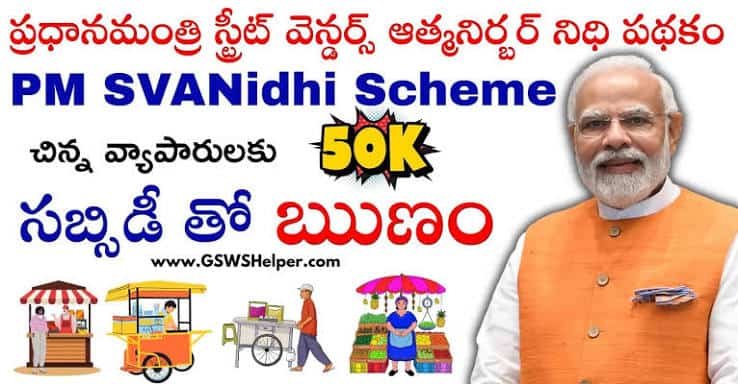
What Is PM SVANidhi?
PM SVANidhi was launched on June 1, 2020 by the Ministry of Housing and Urban Affairs to provide affordable working capital to street vendors.
It is meant for people who earn their livelihood by selling goods or providing services from streets, footpaths, pavements, temporary structures or by moving from place to place.
Eligible activities can include:
- Vegetable selling
- Fruit vending
- Street-food stalls
- Tea stalls
- Ready-to-eat food vending
- Clothing and garment vending
- Small household-goods stalls
- Barber services
- Cobbler services
- Laundry services
- Mobile vendors
- Seasonal vendors
- Other eligible street-based services
The restructured scheme is also being expanded beyond statutory towns to census towns, peri-urban areas and other eligible locations in a phased manner.
PM SVANidhi Loan Amount
The current scheme provides three progressive loan tranches.
| Loan Tranche | Maximum Loan | Repayment Period |
| First Loan | ₹15,000 | 12 months |
| Second Loan | ₹25,000 | 18 months |
| Third Loan | ₹50,000 | 36 months |
The loans are repaid through monthly instalments. These revised repayment periods were confirmed by the Ministry of Housing and Urban Affairs in July 2026.
A street vendor does not normally start directly with the ₹50,000 tranche. The higher limits are linked to successful repayment of earlier loans.
Who Is Eligible for PM SVANidhi?
PM SVANidhi is meant for genuine street vendors carrying out eligible vending activity.
Eligible persons can include:
- Stationary street vendors
- Mobile vendors
- Seasonal vendors
- Women street vendors
- Migrant vendors
- Vendors operating from temporary stalls
- Vendors providing eligible street-based services
The Ministry has confirmed that seasonal, mobile, women and tourism-dependent street vendors can be covered provided they satisfy the scheme’s eligibility conditions.
Identification of street vendors is generally carried out by State Governments, Urban Local Bodies and Town Vending Committees under the Street Vendors Act.
Certificate of Vending or Letter of Recommendation
A major part of PM SVANidhi eligibility is proving that the applicant is genuinely engaged in street vending.
An applicant may have:
- Certificate of Vending (CoV)
- Street-vendor identity card
- Letter of Recommendation (LoR) issued through the appropriate Urban Local Body or Town Vending Committee
A vendor holding a valid CoV or LoR can apply through the PM SVANidhi portal, mobile application or with assistance from the Urban Local Body.
What If the Vendor Was Not Included in the Survey?
Being left out of an earlier street-vendor survey does not necessarily mean that the person can never qualify.
A genuine vendor may approach the concerned Urban Local Body for verification and issuance of the required Letter of Recommendation where applicable.
Proof supporting the vending activity can include documents such as:
- Previous vending-related loan records
- Membership of a vendor association
- Local evidence of vending activity
- Other documents accepted by the Urban Local Body
The local authority may carry out verification before issuing the LoR.
This provision is particularly useful for migrant, seasonal and previously unidentified street vendors.
Can Vendors Living Outside the City Apply?
Eligibility is not necessarily restricted to someone who lives inside the municipal boundary.
A vendor may live in a nearby rural or peri-urban area but carry out vending within an eligible town or city.
The restructured scheme is also expanding geographically into census towns and peri-urban areas in a phased manner.
Applicants should confirm whether their particular location has been included in the current rollout.
PM SVANidhi Interest Rate
The lender charges its applicable rate of interest on the working-capital loan. PM SVANidhi does not impose one universal lending rate on every participating financial institution.
However, eligible vendors receive an interest subsidy of 7% per annum for timely or regular repayment.
Example
Suppose the bank charges 11% annual interest on an eligible PM SVANidhi loan.
The vendor repays according to the prescribed schedule.
The scheme’s 7% interest subsidy substantially reduces the effective interest burden borne by the vendor, subject to the applicable calculation and scheme conditions.
The interest subsidy is therefore one of the most important benefits of maintaining regular repayments.
How Does the 7% Interest Subsidy Work?
The government does not simply reduce every lender’s stated interest rate to 7%.
Instead, eligible borrowers who repay regularly receive an interest subsidy calculated at 7% per annum according to scheme rules.
The subsidy is linked to repayment performance.
This means a borrower who repeatedly delays instalments can lose important scheme benefits.
Is Collateral Required?
No conventional collateral is required for eligible PM SVANidhi working-capital loans.
The scheme specifically provides collateral-free credit to street vendors and includes government-backed credit-guarantee support.
Therefore, a vegetable seller or street-food vendor is not expected to mortgage a house or land simply to obtain the small working-capital facility.
However, the lender still carries out identity and eligibility checks before sanction.
First PM SVANidhi Loan – Up to ₹15,000
A new eligible vendor can obtain a first working-capital loan of up to ₹15,000.
The repayment period is 12 months.
The amount can be used for genuine business requirements such as:
- Buying stock
- Raw materials
- Food ingredients
- Packaging material
- Small equipment
- Other daily working-capital requirements
Timely repayment becomes important because it opens the route to the next loan tranche.
Second Loan – Up to ₹25,000
After successfully repaying the first tranche, an eligible borrower can move to the second tranche of up to ₹25,000.
The revised repayment tenure for this loan is 18 months.
The higher limit helps an established vendor gradually expand the business rather than becoming over-indebted through a large first loan.
Third Loan – Up to ₹50,000
After successful repayment of the second tranche, an eligible vendor may qualify for the third loan of up to ₹50,000.
The current repayment period is 36 months.
This can allow a vendor to make a more meaningful business investment after establishing a good repayment record.
Why Timely Repayment Is Important
Timely repayment provides several advantages.
A vendor can:
- Receive the 7% interest subsidy
- Become eligible for the next higher loan tranche
- Build a formal credit record
- Improve future access to bank finance
- Become eligible for additional facilities under the restructured scheme
The progressive structure is deliberately designed to reward good repayment behaviour.
UPI-Linked RuPay Credit Card
The restructured PM SVANidhi scheme has introduced a UPI-linked RuPay Credit Card for eligible vendors.
Street vendors who successfully repay the second loan can qualify for a credit-card limit of up to ₹30,000.
This facility can help vendors meet sudden business requirements without taking another informal loan.
For example, a vendor may need urgent funds to purchase stock when wholesale prices temporarily fall or when demand suddenly increases during a festival.
Digital Transaction Cashback
PM SVANidhi also encourages vendors to accept and make digital payments.
Under the restructured scheme, eligible vendors can earn cashback of up to ₹1,600 through prescribed retail and wholesale digital transactions.
The revised incentives include benefits for regular digital sales as well as qualifying wholesale purchases.
Digital payments also help create a visible transaction history, which can be useful when the vendor later approaches formal lenders for larger finance.
Documents Required for PM SVANidhi Loan
Documentation is relatively simple compared with many conventional business loans.
Applicants may need:
- Aadhaar card
- Mobile number linked with Aadhaar where required
- Certificate of Vending
- Vendor identity card
- Letter of Recommendation, where applicable
- Bank account details
- Passport-size photograph
- Other accepted KYC documents
Depending on the applicant and lender, additional KYC documents may include:
- Voter ID
- Driving licence
- PAN
- Other accepted identification documents
The exact requirement should be checked on the current portal or with the lender.
How To Apply for PM SVANidhi Loan
Step 1: Check Vendor Eligibility
Make sure you have a valid CoV, vendor identification or LoR.
If you have no document proving your vending status, approach the concerned Urban Local Body first.
Step 2: Apply Through the Official Channel
Eligible vendors can apply through:
- PM SVANidhi portal
- PM SVANidhi mobile application
- Urban Local Body
- Authorised banking or field facilitators
The official digital platform handles the application and lender-processing journey.
Step 3: Enter Personal and Vending Details
Provide information such as:
- Name
- Aadhaar
- Mobile number
- Vending location
- Vendor identification
- Bank account
- Loan requirement
All details should match official records.
Step 4: Select the Lending Institution
Applications can be financed through participating:
- Scheduled Commercial Banks
- Regional Rural Banks
- Cooperative banks
- Small Finance Banks
- NBFCs
- Micro Finance Institutions
- Other participating lenders
Availability can differ by location.
Step 5: Verification
The lender and concerned authority verify the vendor’s eligibility, KYC and application details.
According to the Ministry, the average time taken to sanction a PM SVANidhi loan was around 23 days, although actual time depends on verification and completion of formalities.
Step 6: Loan Disbursement
Once sanctioned, the loan is credited through the formal banking system.
The vendor should use the amount for business working-capital needs and maintain regular monthly repayments.
Can a Vendor Repay the Loan Early?
Yes. PM SVANidhi encourages timely as well as early repayment.
Successful repayment allows the vendor to progress to the next loan tranche.
Borrowers considering early closure should still confirm the loan-account procedure with their lending institution.
Does PM SVANidhi Provide Loan Waiver?
No.
PM SVANidhi is a loan programme, not a loan-waiver scheme.
The borrower must repay the amount according to the agreed schedule.
Government support comes mainly through:
- 7% interest subsidy
- Credit-guarantee support
- Digital-payment incentives
- Progressive higher loan limits
- Financial inclusion and welfare linkages
Applicants should avoid anyone claiming that the government will automatically waive the principal amount after the loan is taken.
SVANidhi Se Samriddhi Benefits
PM SVANidhi is also linked with the SVANidhi se Samriddhi initiative.
Under this programme, beneficiary families can be profiled and connected with selected Central Government welfare schemes for which they are eligible.
This broadens PM SVANidhi beyond just a working-capital loan and helps eligible street-vendor families access social-security benefits.
Important Points Before Applying
Street vendors should remember that the present first-loan limit is ₹15,000, not the older ₹10,000 limit.
Similarly:
- First tranche: up to ₹15,000 for 12 months
- Second tranche: up to ₹25,000 for 18 months
- Third tranche: up to ₹50,000 for 36 months
- Interest subsidy: 7% for eligible timely repayment
- Conventional collateral: Not required
- RuPay credit card: Up to ₹30,000 for eligible borrowers after repayment of the second tranche
- Scheme lending period: Extended until March 31, 2030
As of July 12, 2026, about 76.95 lakh street vendors had received 1.15 crore PM SVANidhi loans worth ₹18,475.06 crore, showing the large scale on which the programme is now being used.
Conclusion
PM SVANidhi gives eligible street vendors access to small collateral-free working-capital loans with progressively higher limits. Regular repayment is especially important because it provides the 7% interest subsidy and allows borrowers to move from ₹15,000 to ₹25,000 and eventually ₹50,000 financing.