Manufacturing businesses use different production methods to convert raw materials into finished products. The choice of manufacturing technology can influence product quality, production speed, labour requirements and overall operating costs. Two commonly used approaches are CNC manufacturing and traditional manufacturing. Both methods are important in industries such as automobiles, engineering, furniture, electronics and metal fabrication, but they differ in how machines are operated and how products are made.
CNC manufacturing uses computer-controlled machines to perform operations such as cutting, drilling, milling and turning. Traditional manufacturing generally relies on manually operated machines, conventional tools and skilled workers to complete production tasks. While CNC technology offers precision and automation, traditional manufacturing can be more practical for simple jobs, small workshops and customised production.
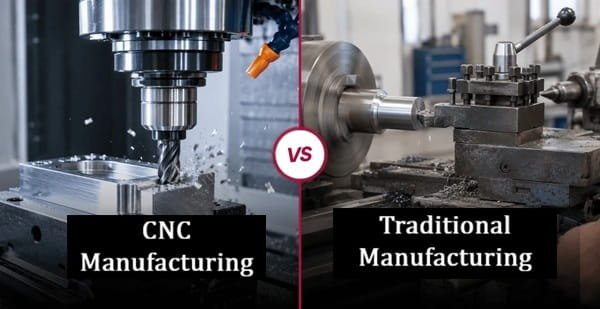
For manufacturers and entrepreneurs, selecting the right method depends on production volume, product complexity, investment capacity and quality requirements. Understanding their differences can help businesses make informed decisions.
What Is CNC Manufacturing?
CNC stands for Computer Numerical Control. CNC manufacturing is a production process in which machines are controlled through computer programmes to perform specific operations on materials such as metal, plastic and wood.
The operator creates or uses a digital design and converts it into machine instructions. The CNC machine follows these instructions to manufacture components with a high level of accuracy and repeatability.
Common CNC machines include:
- CNC milling machines
- CNC turning machines
- CNC routers
- CNC laser cutting machines
- CNC plasma cutting machines
- CNC drilling machines
CNC manufacturing is widely used in automotive components, aerospace parts, medical equipment, industrial machinery and precision engineering.
Its main advantage is that programmed operations can be repeated consistently, making it suitable for manufacturing complex components and producing large quantities with controlled specifications.
What Is Traditional Manufacturing?
Traditional manufacturing refers to production methods that use manually operated or conventionally controlled machines and tools. Skilled workers perform operations such as cutting, shaping, drilling, grinding, welding and assembling materials.
Examples of traditional manufacturing equipment include:
- Manual lathes
- Conventional milling machines
- Hand drills
- Grinding machines
- Manual cutting tools
- Conventional welding equipment
Traditional manufacturing is commonly used in small workshops, repair units, fabrication businesses and industries where production requirements are relatively simple.
It often depends heavily on the experience and skills of workers. Although it may not provide the same level of automation as CNC manufacturing, it can be cost-effective for certain jobs and smaller production quantities.
CNC Manufacturing vs Traditional Manufacturing: Key Differences
| Basis | CNC Manufacturing | Traditional Manufacturing |
| Machine operation | Computer-controlled | Mostly manual or conventionally controlled |
| Precision | Generally high | Depends heavily on operator skill |
| Production speed | Faster for repeated programmed tasks | Often slower for repetitive operations |
| Initial investment | Generally higher | Comparatively lower |
| Labour requirements | Skilled programming and machine operation | Skilled manual operators |
| Repeatability | High when properly programmed | Can vary between operators and production runs |
| Complex designs | Suitable for complex components | More difficult and time-consuming |
| Production volume | Suitable for medium and large production runs | Suitable for small batches and individual jobs |
| Flexibility | Requires programme changes and setup | Manual adjustments can be convenient for simple jobs |
| Maintenance | Requires specialised maintenance | Often easier to maintain with conventional skills |
Production Speed and Efficiency
CNC manufacturing can improve production efficiency because machines automatically perform programmed operations. Once the machine is properly set up, it can repeat the same process with limited manual intervention.
This reduces the time required for many repetitive tasks and helps manufacturers maintain consistent production schedules.
Traditional manufacturing often requires workers to manually adjust machines and perform individual operations. This can increase production time, particularly when manufacturing large quantities of identical components.
However, traditional methods may be faster and more economical for simple repairs, one-off jobs or small production batches where CNC programming and setup would take considerable time.
Accuracy and Product Quality
Accuracy is one of the major advantages of CNC manufacturing. Computer-controlled movements help machines produce components according to specified dimensions and tolerances.
This is particularly important in industries where even small dimensional differences can affect product performance, such as aerospace, automotive and medical equipment manufacturing.
Traditional manufacturing quality depends significantly on operator experience, machine condition and measurement practices. Skilled workers can produce highly accurate components, but maintaining consistency across large production runs may be more challenging.
It is important to understand that CNC machines do not automatically guarantee perfect quality. Proper programming, tooling, calibration, material selection and inspection are still necessary.
Initial Investment and Operating Costs
CNC manufacturing generally requires higher initial investment. Businesses must purchase CNC machines, computers, software, cutting tools and supporting equipment. They may also need to invest in operator training, programming expertise and specialised maintenance.
Traditional manufacturing usually has lower entry costs because conventional machines and tools are often less expensive than advanced CNC systems.
However, operating costs should be evaluated over the long term. CNC machines can reduce labour requirements, material waste and production time in suitable applications. Traditional manufacturing may involve higher labour costs when large quantities of products are manufactured manually.
Which is better? Traditional manufacturing may be more affordable for small workshops, while CNC manufacturing can provide better long-term value when production volumes and precision requirements justify the investment.
Labour and Skill Requirements
CNC manufacturing requires employees who understand machine operation, technical drawings, programming, tooling and production processes. Although automation reduces some manual tasks, skilled operators and technicians remain essential.
Traditional manufacturing relies more directly on workers who have practical experience operating machines and handling tools. Their ability to measure, adjust and shape materials can significantly influence product quality.
Both methods require training, but the type of expertise differs.
Flexibility and Product Customisation
Traditional manufacturing can be useful for custom repairs, prototypes and simple modifications. Workers can make manual adjustments without necessarily preparing a detailed machine programme.
CNC manufacturing also supports customisation, but changes may require modifying digital designs, machine programmes and production setups. Once the programme is ready, however, producing multiple customised components can become more consistent and efficient.
Therefore, the better option depends on how frequently designs change and how complex the products are.
Which Manufacturing Method Is More Suitable?
CNC manufacturing may be more suitable if your business:
- Produces complex components with precise dimensions.
- Needs consistent quality across repeated production runs.
- Manufactures products in medium or large quantities.
- Wants to improve automation and production efficiency.
- Has sufficient investment for advanced machinery.
Traditional manufacturing may be a better option if your business:
- Has limited initial investment.
- Handles small production batches.
- Performs repairs and customised jobs.
- Manufactures relatively simple components.
- Has access to experienced machine operators.
Some manufacturers use both approaches. For example, a workshop may use CNC machines for precision cutting and conventional machines for repairs, finishing or smaller customised tasks. This combination can help businesses balance productivity, investment and flexibility.
Conclusion
CNC manufacturing and traditional manufacturing both play important roles in modern industrial production. CNC technology offers automation, precision, repeatability and efficiency, making it suitable for complex components and higher production volumes. However, it requires greater initial investment, technical expertise and specialised maintenance.
Traditional manufacturing offers lower entry costs and practical flexibility for small workshops, simple components and individual jobs. Its limitations may include slower production and greater dependence on manual skills when handling repetitive work.
If your business requires precision, consistency and higher production capacity, CNC manufacturing may be the better choice. If you are starting a small workshop or handling simple customised work, traditional manufacturing may be more practical.
Ultimately, the most suitable method depends on product complexity, production volume, budget and long-term business requirements.
Frequently Asked Questions (FAQs)
Q. Is CNC manufacturing better than traditional manufacturing?
CNC manufacturing is generally better for precision, repeatability and automated production. Traditional manufacturing can be more suitable for simple jobs, repairs and small production batches.
Q. Is CNC manufacturing more expensive?
CNC manufacturing usually requires higher initial investment because of machine costs, software and technical requirements. However, it may reduce production costs over time when machines are used efficiently.
Q. Can small businesses use CNC machines?
Yes. Small businesses can use CNC machines for specialised manufacturing, woodworking, metal fabrication and customised production. They should select equipment according to their budget and expected workload.
Q. Which manufacturing method provides better accuracy?
CNC manufacturing generally provides better repeatability and dimensional consistency. However, actual accuracy depends on machine condition, programming, tooling, calibration and operator expertise.
Q. Does CNC manufacturing eliminate the need for skilled workers?
No. CNC manufacturing still requires skilled programmers, operators, technicians and quality-control professionals to prepare programmes, operate machines and inspect finished products.
Q. Can CNC and traditional manufacturing be used together?
Yes. Many manufacturing businesses combine both methods. CNC machines can handle precision and repetitive operations, while conventional machines can be used for repairs, adjustments and smaller customised jobs.