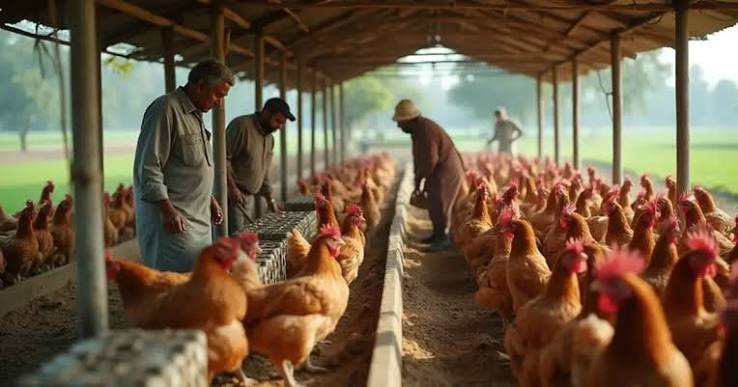
Starting a poultry farm requires more than simply purchasing chicks. A commercial unit needs a proper shed, feeders, drinkers, heating and ventilation arrangements, medicines, vaccines, feed storage, electricity, water and enough working capital to manage the birds until they are ready for sale or start producing eggs. For a medium-sized poultry business, these costs can quickly run into several lakh rupees.
Fortunately, poultry farming is recognised as an eligible agricultural and allied activity by banks in India. Farmers and entrepreneurs can obtain term loans for setting up the farm and working-capital finance for recurring expenses. Government support is also available under certain schemes, but there is no single subsidy rate applicable to every poultry farm.
Two important Central Government routes are the National Livestock Mission (NLM) and Prime Minister’s Employment Generation Programme (PMEGP). However, they support different types of poultry projects. NLM’s major poultry subsidy is specifically aimed at rural poultry breeding infrastructure, while PMEGP can support eligible new poultry enterprises on a broader basis.
Understanding this difference is essential before preparing a project report or applying for a loan.
What Can a Poultry Farm Loan Be Used For?
Banks can finance both fixed investment and operating expenses of a viable poultry project.
A poultry farm loan may cover:
- Construction of poultry sheds
- Purchase of chicks or birds
- Feeders and drinkers
- Brooding equipment
- Ventilation and cooling systems
- Feed storage
- Water supply arrangements
- Electrical installations
- Egg-handling equipment
- Medicines and vaccination expenses
- Feed and other working capital
- Hatchery equipment
- Biosecurity facilities
- Other approved farm equipment
Punjab National Bank’s poultry financing scheme, for example, provides investment credit for sheds and equipment along with production credit for chicks, feed, medicines and other operating requirements.
Who Is Eligible for a Poultry Farm Loan?
Eligibility varies from bank to bank, but poultry finance is generally available to applicants who can establish that the project is technically and financially viable.
Possible borrowers include:
- Individual farmers
- Poultry entrepreneurs
- Small and marginal farmers
- Landless agricultural workers with suitable premises
- Self Help Groups
- Joint Liability Groups
- Farmer Producer Organisations
- Partnership firms
- Companies and cooperatives involved in agriculture or allied activities
Applicants generally need adequate land or a suitable shed for establishing the poultry unit.
For commercial projects, banks may also look for prior experience, training or reasonable knowledge of poultry management.
PNB’s poultry scheme, for example, provides for financing small farmers, landless agricultural labourers and other eligible persons undertaking poultry as a supplementary activity. For a commercial main activity, the bank expects the applicant to have suitable experience and infrastructure. Its published scheme mentions a minimum financing unit of 500 birds.
How Much Poultry Farm Loan Can You Get?
There is no fixed maximum loan amount applicable to every poultry borrower.
Loan size depends on:
- Number of birds
- Broiler, layer or breeder model
- Shed construction cost
- Equipment
- Feed requirement
- Land and infrastructure
- Working capital
- Expected sales
- Applicant’s repayment capacity
For example, SBI’s published poultry finance product covers broiler production, egg production, pullet production and breeder-bird units and provides need-based finance ranging from ₹1 lakh to substantially larger commercial amounts.
A small 1,000-bird broiler operation therefore cannot expect the same loan amount as a commercial breeder or hatchery project.
Poultry Farm Loan Margin or Down Payment
Banks normally require borrowers to contribute part of the project cost themselves. This contribution is called the margin.
There is no single fixed margin percentage for all poultry loans.
Depending on the bank and loan amount, the borrower may have to contribute around:
- Nil margin for some small agricultural credit facilities
- Around 10% for certain medium-sized loans
- Around 15% for larger amounts
- 20% to 25% or more for higher-risk or larger projects
For example, PNB’s current general agricultural investment-credit guidelines provide:
| Agricultural Investment Loan | Indicative Margin |
| Up to ₹2 lakh | Nil |
| Above ₹2 lakh to ₹10 lakh | 10% |
| Above ₹10 lakh to ₹25 lakh | 15% |
| Above ₹25 lakh | 25% |
These are bank-specific norms and should not be treated as a nationwide poultry-loan rule.
Government Subsidy for Poultry Farming
Government support depends heavily on the type of poultry project.
The two schemes most relevant to many applicants are:
1. National Livestock Mission
The National Livestock Mission Entrepreneurship Development Programme (NLM-EDP) provides major capital subsidy support for qualifying rural poultry breeding projects.
Under the current scheme, the Central Government provides 50% capital subsidy, subject to a maximum of ₹25 lakh, for establishment of an eligible rural poultry breeding project.
However, this benefit is not meant for every ordinary broiler shed.
The eligible rural poultry project is specifically designed around establishment of:
- Parent farm
- Rural hatchery
- Brooder-cum-mother unit
The prescribed model requires a minimum of 1,000 female parent birds and 100 male birds and focuses on production of hatching eggs, chicks and rearing chicks up to four weeks.
NLM Poultry Subsidy Breakdown
Suppose an approved rural poultry breeding project costs ₹50 lakh.
The government assistance can be:
- Total project cost: ₹50 lakh
- NLM capital subsidy at 50%: ₹25 lakh
- Remaining project cost: ₹25 lakh
The remaining amount can be arranged through:
- Bank loan
- Financial institution finance
- Applicant’s own funds
- A combination of loan and own contribution
The subsidy ceiling remains ₹25 lakh for this poultry component.
Who Can Apply Under NLM Poultry Scheme?
Eligible entities include:
- Individuals
- Self Help Groups
- Farmer Producer Organisations
- Farmer Cooperatives
- Joint Liability Groups
- Section 8 companies
The applicant must establish the prescribed rural poultry breeding infrastructure and meet the technical and financial conditions of the scheme.
The government’s NLM dashboard showed 172 approved rural poultry projects as of August 2026, confirming that the scheme remains operational.
How To Apply for NLM Poultry Subsidy
Applications are submitted through the NLM Udyamimitra portal.
The broad process is:
- Prepare the poultry project report.
- Register and submit the online application.
- Upload required supporting documents.
- Select the financing institution, where bank finance is required.
- Application is scrutinised by the State Implementing Agency.
- The proposal proceeds through the prescribed State-level recommendation process.
- DAHD examines and approves eligible subsidy proposals.
- The lender sanctions and disburses the eligible loan.
- Subsidy is released according to scheme conditions.
The official NLM process provides for subsidy release linked to implementation of the approved project.
PMEGP Subsidy for Poultry Farm
An entrepreneur planning a new poultry farm should also examine PMEGP.
KVIC has officially clarified that animal-husbandry activities such as poultry, dairy and aquaculture are permitted under PMEGP.
Poultry activities are treated under the service sector, and the maximum project cost eligible for subsidy under the first PMEGP loan is currently ₹20 lakh. The cost of livestock or birds can also be considered under capital expenditure according to applicable NABARD unit-cost norms.
PMEGP Poultry Subsidy Rates
| Applicant Category | Own Contribution | Urban Subsidy | Rural Subsidy |
| General | 10% | 15% | 25% |
| Special Category | 5% | 25% | 35% |
Special-category applicants can include eligible women, SC, ST, OBC, minorities, ex-servicemen, persons with disabilities and other specified categories.
PMEGP Poultry Subsidy Example
Consider a general-category entrepreneur establishing an eligible ₹12 lakh poultry farm in a rural area.
The broad structure could be:
- Project cost: ₹12 lakh
- Applicant contribution at 10%: ₹1.20 lakh
- Bank finance: up to ₹10.80 lakh
- Eligible subsidy at 25%: ₹3 lakh
The ₹3 lakh subsidy is not normally handed to the applicant in cash. It is held under the prescribed margin-money mechanism and later adjusted against the loan after fulfilment of PMEGP conditions.
PMEGP is available only for eligible new enterprises under its first-loan component.
NLM vs PMEGP for Poultry Farming
The schemes should not be confused.
| Feature | NLM Poultry | PMEGP Poultry |
| Main purpose | Rural poultry breeding infrastructure | New poultry micro enterprise |
| Subsidy | 50% capital subsidy | |
| Maximum poultry subsidy | ₹25 lakh | Depends on category and project cost |
| Poultry model | Parent farm + hatchery + mother unit | Wider eligible poultry activities |
| Minimum NLM parent stock | 1,000 females + 100 males | No identical NLM requirement |
| Maximum PMEGP eligible service project | Not applicable | ₹20 lakh |
For an ordinary small broiler or layer farm, PMEGP or normal agricultural finance may be more relevant than the NLM rural poultry breeding subsidy.
Kisan Credit Card for Poultry Working Capital
Farmers already engaged in poultry can also obtain working-capital assistance through the Kisan Credit Card for Animal Husbandry and Fisheries.
KCC can help pay recurring expenses such as:
- Chicks
- Feed
- Medicines
- Vaccines
- Electricity
- Labour
- Other routine poultry expenses
The credit limit is generally determined according to the local Scale of Finance fixed by the District or State Level Technical Committee.
KCC should not be confused with a capital subsidy. It is mainly a credit facility for short-term operating requirements.
Documents Required for Poultry Farm Loan
Banks and subsidy schemes may ask for:
- Aadhaar
- PAN
- Photographs
- Address proof
- Land ownership or lease documents
- Poultry farm project report
- Shed layout or construction estimate
- Equipment quotations
- Bird/chick cost estimates
- Bank statements
- Existing loan details
- Training or experience certificate, where required
- Category certificate for subsidy benefits
- Approvals from local authorities where applicable
Larger commercial farms may require additional environmental, pollution-control or local-body permissions depending on their size and location.
What Should a Poultry Project Report Include?
Banks pay particular attention to the project report because poultry farming carries biological and market risks.
A good DPR should explain:
- Type of poultry unit
- Number of birds
- Number of production cycles
- Chick cost
- Feed consumption
- Mortality assumptions
- Expected body weight or egg production
- Sale price
- Shed and equipment cost
- Veterinary expenses
- Labour
- Electricity
- Insurance
- Working capital
- Expected revenue
- Profitability
- Loan repayment capacity
Avoid preparing projections on the assumption of zero mortality or permanently high poultry prices.
Poultry Loan Repayment Period
Repayment depends on the type of finance.
Short-term production loans may be repaid after the relevant poultry cycle.
Long-term investment loans for sheds and equipment can extend over several years. PNB’s poultry scheme, for example, provides investment-loan repayment over approximately 6 to 7 years for eligible small farmers, depending on repayment capacity.
SBI’s broader commercial poultry finance product provides repayment extending up to 120 months, including a permitted moratorium period under its product conditions.
Common Reasons Poultry Loans Are Rejected
Applications can fail because of:
- Inadequate land or shed
- Poor CIBIL history
- Insufficient own contribution
- Unrealistic poultry prices
- Excessive mortality assumptions being ignored
- Weak feed and chick supply arrangements
- No reliable market for birds or eggs
- Incomplete documents
- Excessively large project for an inexperienced applicant
- Existing overdue loans
Applicants should also demonstrate proper biosecurity and disease-management arrangements because an outbreak can seriously affect repayment capacity.
Important Points Before Applying
Do not assume that every poultry loan comes with a 50% government subsidy. The 50% NLM benefit applies to the prescribed rural poultry breeding model, not automatically to every broiler or layer farm.
For a smaller new poultry business, examine PMEGP, State Government poultry schemes and ordinary agricultural bank finance. For recurring feed and chick expenses, KCC may also be useful.
Conclusion
Poultry farm finance is available through banks, PMEGP, NLM and agricultural credit programmes, but each serves a different purpose. Choosing the correct scheme and preparing a realistic project report are the two most important steps before applying for finance.